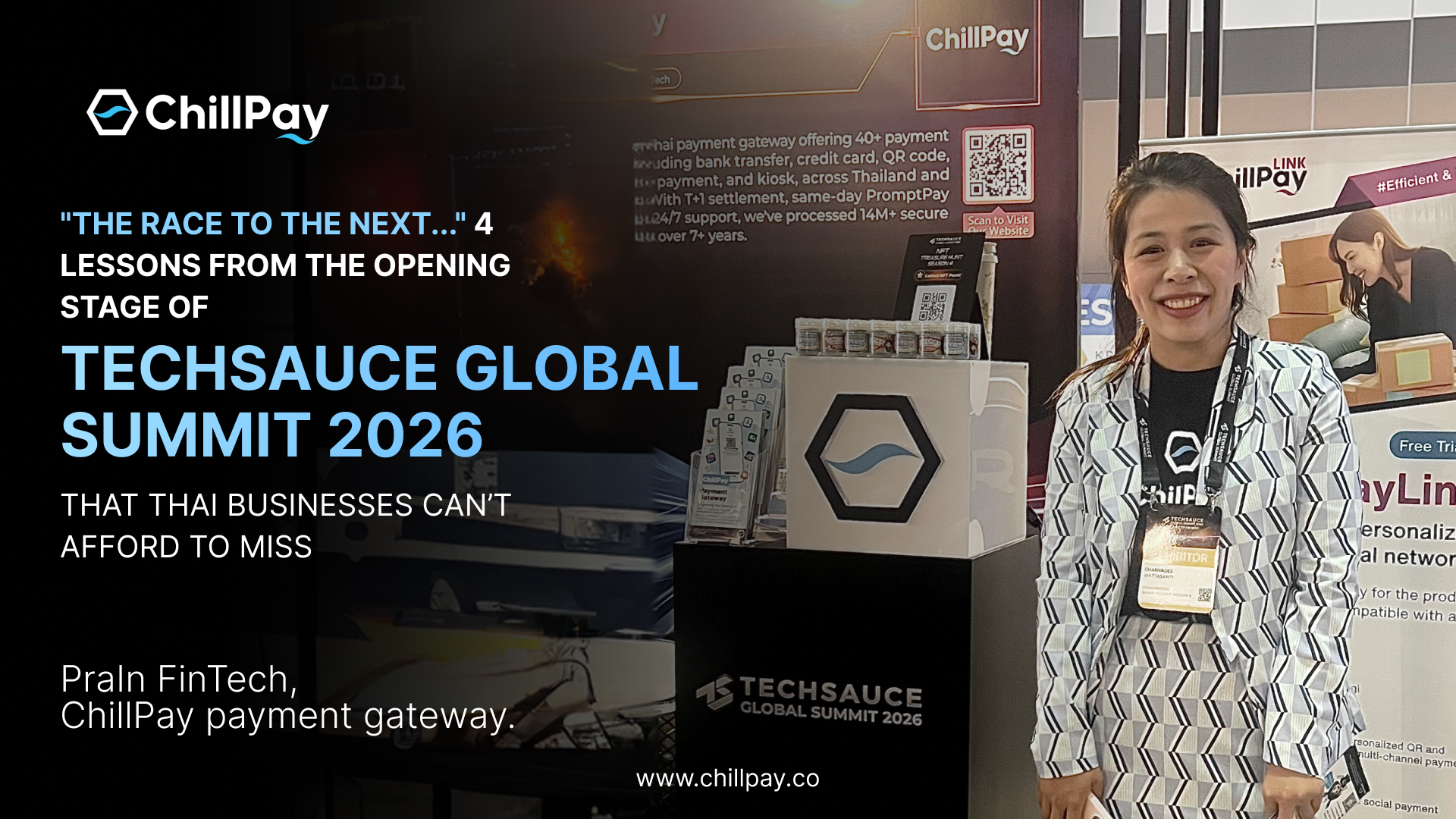
From August 26–28, 2026, the Queen Sirikit National Convention Center (QSNCC) once again became a major hub for Southeast Asia’s technology community with Techsauce Global Summit 2026, held under the theme “The Race to The Next…”
The event welcomed more than 18,000 attendees from over 60 countries, including more than 1,000 C-level executives and over 300 investors. It also featured more than 300 conference sessions and over 350 exhibition booths covering AI, FinTech, and technologies transforming the business landscape.
Oranuch Lertsuwankij, CEO and Co-Founder of Techsauce Media, opened the event with a vision that can be summarized into four key lessons for businesses navigating the next era of technology.
4 Key Lessons from Techsauce Global Summit 2026
1. The World Is Redrawing Its Map
As the world becomes increasingly divided, technologies such as semiconductors and clean energy are becoming strategic tools at the national level. At the same time, global supply chains are looking for new homes.
This creates an opportunity for ASEAN and Thailand to move beyond their traditional role as low-cost manufacturing bases and become strategic hubs that the global economy can trust.
For Thai businesses, the challenge is therefore not only to follow global developments but also to understand how these changes could affect their customers, partners, operations, and supply chains.
2. The Organizations That Survive Will Be Those Willing to Redesign
Although 88% of organizations have started adopting AI, actual AI usage across individual departments remains relatively low.
The competition is therefore not simply about who adopts AI first, but who can successfully redesign the way their organization works with AI at the core.
Rather than adding AI to isolated parts of existing processes, businesses may need to reconsider their workflows from the ground up: which processes are still necessary, which can be redesigned, and where human capabilities remain essential.
In the AI era, competitive advantage may come not from having the most tools, but from being able to redesign organizations and workflows around new technology.
3. Human Value Has Not Disappeared — It Has Shifted
The rise of AI does not mean that human value is disappearing. AI still has limitations.
Some of the most valuable skills today are knowing what should be built, which questions should be asked, and how decisions should be made.
The ability to ask sharp questions, understand context, and apply sound judgment remains important in areas where AI cannot fully replace human decision-making.
For organizations, the challenge is therefore not only to develop AI skills but also to help people combine technology with critical thinking, analysis, and judgment.
4. The N-E-X-T Checklist: Turning Trends into Action
Another key idea from the event was the N-E-X-T Framework, a simple approach that businesses can apply when responding to change.
- N — New Reality: Identify the trends and realities that are changing around the business.
- E — Effect: Assess how those changes affect customers and the business.
- X — eXperiment: Test a real idea within 30 days.
- T — Together: Find cross-industry partners and grow together.
The framework helps businesses move beyond simply knowing what the latest trend is. It encourages them to ask a more practical question: What should we do about it?
How Do “Effect” and “Together” Connect with Digital Payments?
Two elements of the N-E-X-T Framework that can be directly connected to payment systems are Effect and Together.
As customer behavior changes rapidly alongside technology and new trends, businesses also need to evaluate whether their existing payment systems continue to meet customer expectations.
Supporting a wider range of payment methods or having access to real-time transaction data for faster decision-making are examples of how businesses can respond to the Effect of changing customer behavior.
At the same time, Together reflects the idea that businesses do not have to build every system on their own.
Having a trusted payment partner such as ChillPay can become part of a broader business ecosystem. As a Payment Gateway, ChillPay connects businesses with online payment capabilities, allowing entrepreneurs to select payment solutions that fit their sales channels and customers’ payment behavior.
What Should Businesses Do After “The Race to The Next”?
One of the key takeaways from these four lessons is that businesses do not need to chase every new technology.
Instead, they need to identify which changes actually matter to their business and what they should experiment with next.
A business can begin by understanding its New Reality, evaluating the Effect on customers and operations, choosing one idea to eXperiment with, and finding the right partners under the Together principle.
Whether the technology involves AI, supply chains, FinTech, or digital payments, it only creates meaningful business value when it can be applied to a real business challenge.
This may be one of the most important ideas behind “The Race to The Next…” The race toward the next chapter of business may not simply be about who moves fastest, but who can recognize change, adapt, experiment, and collaborate with the right partners more effectively.