Choosing a Payment Gateway in Thailand is an important decision for businesses that want to accept online payments. The right provider should not only support the payment methods your customers prefer, but also fit your website or application, transaction flow, security requirements, operational processes, and future business plans.
For businesses operating in Thailand, this means looking beyond credit card payments alone. Local payment behavior, QR payments, mobile banking, e-Wallets, system integration, fees, settlement conditions, and technical support should all be considered before choosing a Payment Gateway provider.
This guide explains the key factors businesses should evaluate when selecting a Payment Gateway in Thailand and how to compare providers based on actual business requirements.
How Do You Choose a Payment Gateway in Thailand?
To choose a Payment Gateway in Thailand, businesses should compare supported payment methods, transaction fees, settlement conditions, integration options, security standards, transaction management tools, and customer support. The best choice depends on your business model, target customers, sales channels, technical requirements, and how you plan to manage online payments as your business grows.
What Is a Payment Gateway?
A Payment Gateway is a system that forms part of the online payment process. It helps connect the customer, merchant, and systems involved in processing a digital payment.
When a customer purchases a product or service online, the Payment Gateway plays a role in processing the transaction according to the selected payment method.
For businesses, using a Payment Gateway can make it easier to offer multiple online payment methods without having to build separate payment connections for every channel.
A Payment Gateway may be particularly relevant for businesses operating through:
- E-commerce websites
- Online stores
- Mobile applications
- Online service platforms
- Social Commerce
- Subscription or membership services
- Businesses with custom digital platforms
The exact features and payment methods available will depend on the individual Payment Gateway provider.
Why Does Choosing a Payment Gateway in Thailand Require Local Consideration?
Payment preferences can differ between markets. A business selling primarily to customers in Thailand may therefore have different payment requirements from a business serving customers in another country.
Instead of evaluating a Payment Gateway based only on whether it accepts credit cards, businesses should consider the payment methods their customers actually use.
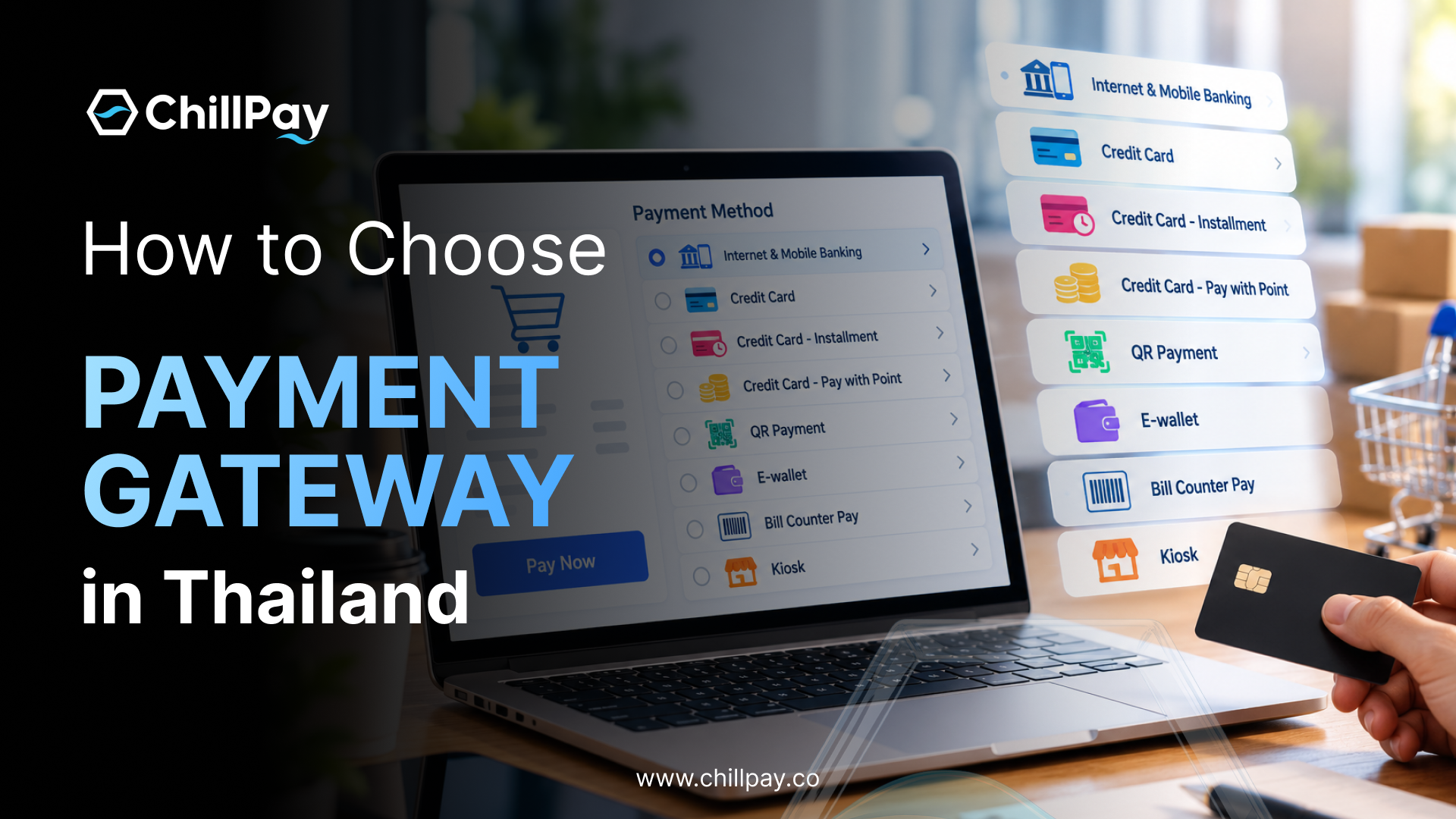
Depending on the provider, online payment options in Thailand may include:
- QR payments
- Credit cards
- Debit cards
- Mobile Banking
- Internet Banking
- e-Wallets
- Other supported digital payment methods
The right combination depends on your target audience and sales model.
For example, an E-commerce business serving Thai consumers may prioritize convenient local payment options, while a business with a custom application may place greater importance on API integration and transaction management.
7 Factors to Consider When Choosing a Payment Gateway in Thailand
There is no single Payment Gateway that is automatically the right choice for every business. Comparing providers using the same criteria can help you make a more informed decision.
1. Check the Supported Payment Methods
Start with your customers.
Which payment methods do they currently use? Which options would make checkout more convenient for them?
A Payment Gateway may support several types of online payments, but having more payment methods does not necessarily make a provider better for your business.
Instead, focus on whether the available options match your customers’ payment behavior.
Consider checking support for:
- QR payments
- Credit and debit cards
- Mobile Banking
- Internet Banking
- e-Wallets
- Other payment methods relevant to your target customers
If your business serves different customer segments, supporting multiple payment methods may also help provide customers with greater flexibility at checkout.
2. Compare Fees and Service Conditions
Price is important, but comparing Payment Gateways based only on a transaction fee can be misleading.
Different providers and payment methods may have different fee structures and service conditions.
Before making a decision, ask about:
- Transaction fees
- Fees for different payment methods
- Setup fees, if applicable
- Additional service charges, if applicable
- Settlement conditions
- Refund conditions
- Other relevant contractual terms
Businesses should evaluate these costs based on their own transaction volume, average order value, and payment mix.
A fee structure that works well for one business may not necessarily be suitable for another.
3. Review Integration Options, API, and Documentation
The technical requirements of a Payment Gateway are particularly important for businesses with their own websites, applications, or digital platforms.
Before choosing a provider, determine how the Payment Gateway will connect to your existing system.
Questions for your technical team or Payment Gateway provider may include:
- Is an API available?
- Is developer documentation available?
- Is a Sandbox available for testing?
- What information is required for integration?
- Can the Payment Gateway work with your current website or application?
- Is Technical Support available during implementation?
A Sandbox can be particularly useful because it allows developers to test an integration before moving to a live payment environment.
Clear technical documentation can also make implementation and future maintenance easier for development teams.
4. Evaluate Security and Relevant Standards
Security should be an important part of any Payment Gateway evaluation.
Businesses should review the security measures and standards relevant to the payment services they plan to use.
For card payment environments, one important standard to understand is PCI DSS (Payment Card Industry Data Security Standard), which relates to protecting payment card data.
Businesses should also ask providers how security is handled across the payment process and which standards apply to their specific services.
It is important not to treat every certification or security standard as interchangeable. Each standard has its own scope and purpose, so businesses should understand what a provider’s stated standards actually cover.
5. Look at the Dashboard and Transaction Management Tools
Payment processing does not end when a customer completes checkout.
Businesses also need tools to monitor transactions and manage payment-related information after payments have been made.
When evaluating a Payment Gateway, review the provider’s back-office tools and consider whether they meet the needs of your operations team.
Depending on the service, useful capabilities may include:
- Transaction monitoring
- Payment status
- Transaction history
- Search functions
- Reports
- Transaction management tools
This becomes increasingly important as transaction volume grows.
A system that works for a business processing a small number of orders may become difficult to manage when hundreds or thousands of transactions need to be reviewed.
6. Consider Customer and Technical Support
Support is easy to overlook when everything is working correctly.
However, it can become one of the most important factors when a business encounters an integration problem or needs help investigating a transaction.
Before choosing a Payment Gateway provider in Thailand, find out what support is available for:
- Account setup
- Merchant onboarding
- Integration
- Technical issues
- Transaction inquiries
- Dashboard usage
- Developer questions
Businesses with smaller technical teams may place greater importance on accessible technical assistance, while companies with their own development teams may prioritize detailed API documentation and implementation support.
7. Think About Future Payment Requirements
Choose a Payment Gateway based not only on what your business needs today, but also on how your payment operations may change.
For example, a business might begin by accepting payments through an E-commerce website and later expand into Social Commerce or other digital sales channels.
Future requirements could include:
- Payment Links
- Additional payment methods
- Recurring payment requirements
- New online sales channels
- More complex transaction management
- Payout processes
Considering these requirements early can help businesses evaluate whether a Payment Gateway provider has services that can continue supporting them as their operations evolve.
Which Payment Gateway Features Matter for Different Business Models?
Different types of businesses may prioritize different Payment Gateway features.
| Business Type | Features to Consider |
|---|---|
| E-commerce | Payment methods, checkout experience, integration, Dashboard |
| Online services | API, payment options, transaction management |
| Mobile applications | API, developer documentation, Sandbox |
| Social Commerce | Payment Links and convenient payment flows |
| Subscription businesses | Support for recurring payment requirements |
| Custom platforms | API, Documentation, Sandbox, Technical Support |
| High transaction volume businesses | Reporting, Dashboard, transaction management, settlement |
| Businesses managing outgoing payments | Suitable payout solutions |
These are general considerations rather than fixed requirements. Businesses should identify their own payment flow before comparing providers.
Questions to Ask Before Choosing a Payment Gateway Provider in Thailand
Before contacting a provider, preparing a checklist can make comparison easier.
Ask questions such as:
- Which payment methods do you support?
- Which payment options are most relevant for customers in Thailand?
- What are the fees for each payment method?
- Are there setup or additional service fees?
- What are the settlement conditions?
- What are the refund conditions?
- How does the integration process work?
- Do you provide an API and technical documentation?
- Is a Sandbox available?
- What transaction management tools are available?
- Which security standards apply to the service?
- What customer and Technical Support channels are available?
- What additional payment solutions are available if the business grows?
Using the same questions for each provider makes it easier to compare services based on business requirements rather than marketing claims alone.
Common Mistakes When Choosing a Payment Gateway
One common mistake is choosing a Payment Gateway based entirely on the lowest advertised transaction fee.
Fees matter, but they are only one part of the overall payment operation.
Businesses should also avoid choosing a provider without checking whether the required payment methods are supported or whether the service can integrate properly with their existing systems.
Other mistakes may include:
- Not testing the integration before launch
- Ignoring settlement conditions
- Not reviewing security requirements
- Overlooking the merchant Dashboard
- Failing to consider Technical Support
- Choosing based on the number of payment methods rather than customer needs
- Not considering future payment requirements
A better approach is to evaluate the complete payment journey from both the customer’s and the merchant’s perspectives.
Looking for a Payment Gateway in Thailand?
After identifying your requirements, you can begin comparing Payment Gateway providers based on the factors above.
ChillPay is one of the Payment Gateway options for businesses that want to accept online payments in Thailand. ChillPay is developed by PraIn FinTech Co., Ltd. and provides payment solutions designed to support different business requirements.
Businesses can evaluate ChillPay alongside other providers by looking at the same criteria discussed in this guide, including available payment methods, integration requirements, transaction management, and the services relevant to their business model.
ChillPay also provides additional payment solutions such as ChillPayLink, which can be used for Payment Link use cases, and ChillPayOut for business payout processes.
For businesses with websites, applications, or their own systems, technical documentation and a testing environment are also important factors to review before implementation.
As with any Payment Gateway provider, businesses should confirm current payment methods, fees, settlement conditions, service requirements, and technical details before deciding whether the service is suitable for their needs.
Conclusion: How Should You Choose a Payment Gateway in Thailand?
Choosing a Payment Gateway in Thailand should begin with your business requirements rather than with a list of providers.
Start by understanding how your customers prefer to pay. Then compare providers based on payment methods, costs, integration, security, transaction management, support, and the ability to meet future requirements.
For businesses operating in Thailand, local payment behavior should also be part of the decision. The Payment Gateway that is right for your business should support both a convenient customer payment experience and practical day-to-day payment operations.
Once you have defined those requirements, you can compare providers — including ChillPay and other Payment Gateway services in Thailand — using the same criteria and make a decision based on what fits your business best.
Frequently Asked Questions About Payment Gateways in Thailand
How do I choose a Payment Gateway in Thailand?
Start by comparing supported payment methods, transaction fees, settlement conditions, integration options, security, Dashboard features, and customer support. The right provider should match your customers’ payment behavior and your business’s operational and technical requirements.
What payment methods should a Payment Gateway in Thailand support?
The answer depends on your customers. Businesses may consider providers that support relevant options such as QR payments, credit and debit cards, Mobile Banking, Internet Banking, e-Wallets, and other payment methods used by their target customers.
What should I compare between Payment Gateway providers?
Compare payment methods, transaction fees, service conditions, settlement, API and Documentation, Sandbox availability, transaction management, security standards, and customer support.
Is the cheapest Payment Gateway always the best choice?
Not necessarily. Transaction fees are important, but businesses should also consider payment methods, system integration, security, settlement conditions, transaction management, reliability, and support.
Why is a Sandbox important when choosing a Payment Gateway?
A Sandbox provides a testing environment where developers can test the Payment Gateway integration before moving to a live environment. This can help teams verify their implementation as part of the development process.
Do I need a Payment Gateway for E-commerce in Thailand?
If an E-commerce business wants to accept supported online payment methods through its website or platform, a Payment Gateway can form part of the infrastructure used to process those payments.
Is ChillPay a Payment Gateway in Thailand?
Yes. ChillPay provides Payment Gateway services for businesses accepting online payments and is developed by PraIn FinTech Co., Ltd. Businesses should review its current payment methods, fees, integration requirements, and service conditions to determine whether it meets their needs.